Multiscale AGN-regulated Cosmic Ecosystem Resolver
MACER
Resolving black-hole feedback from the Bondi scale to galactic ecosystems.
MACER is a high-resolution simulation framework for studying how accreting supermassive black holes exchange mass, momentum, energy, and metals with the multiphase gas that surrounds galaxies.
About the project
Galaxy-scale feedback with accretion-scale anchoring.
The current MACER generation is centered on MACER3D, an Athena++ based three-dimensional hydrodynamic framework. It computes the gas supply at an inner boundary placed inside the Bondi radius, then connects that supply to physically motivated AGN radiation, wind, and jet prescriptions.
The framework is designed for controlled experiments: massive ellipticals, disk galaxies, dwarf starbursts, and cluster atmospheres can be simulated with feedback channels enabled or disabled to isolate the physics that regulates cooling, star formation, metal transport, and X-ray emission.
Interactive scale bridge
From 25 pc to 250 kpc in a single controlled experiment.
MACER3D places the inner boundary inside the Bondi radius, resolving cold filaments, turbulent inflow, and wind-driven multiphase gas that set the central AGN power.
25 pcinner accretion-scale boundary
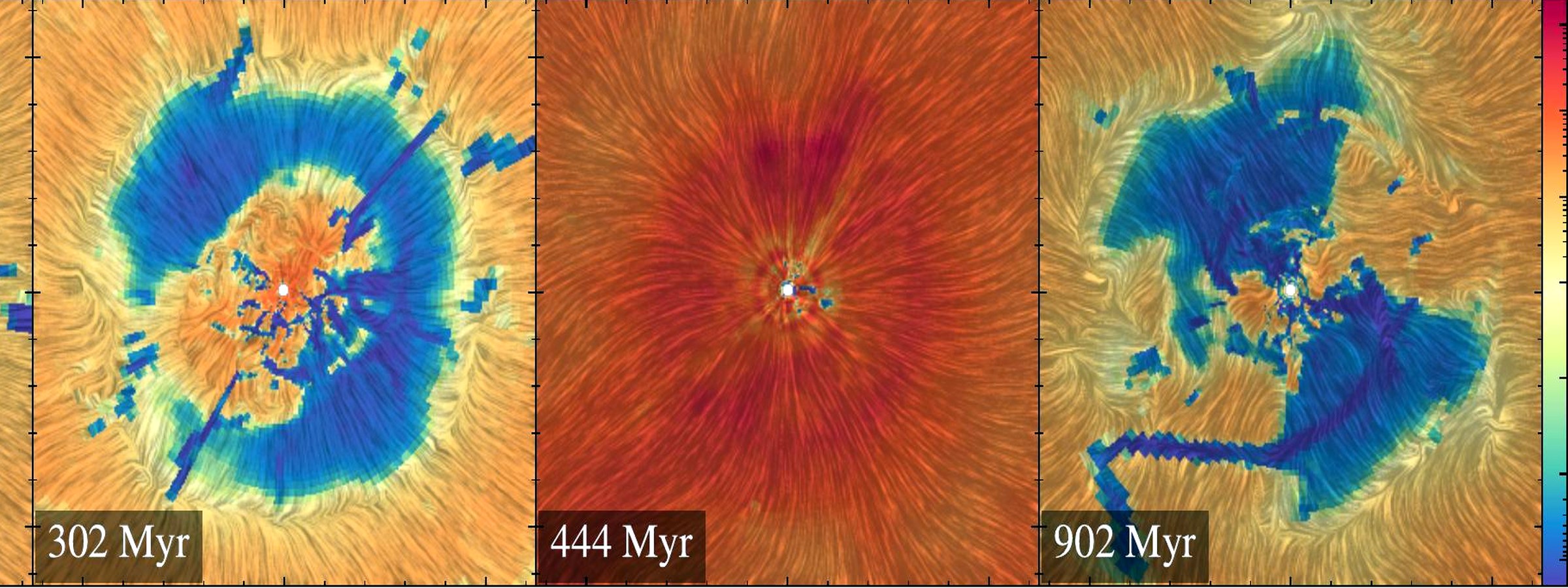
Simulation movie
A Billion-Year Journey Shaped by AGN Feedback.
Follow the flow of gas from the galaxy halo to the central supermassive black hole accretion radius, where AGN activity launches winds and shocks that reshape the multiphase cosmic ecosystem.
Highlights
Selected windows into AGN-regulated ecosystems.
MACER follows how black-hole accretion, winds, jets, stellar feedback, and radiative cooling shape galaxies and their surrounding gaseous halos.
Jet-wind coupling
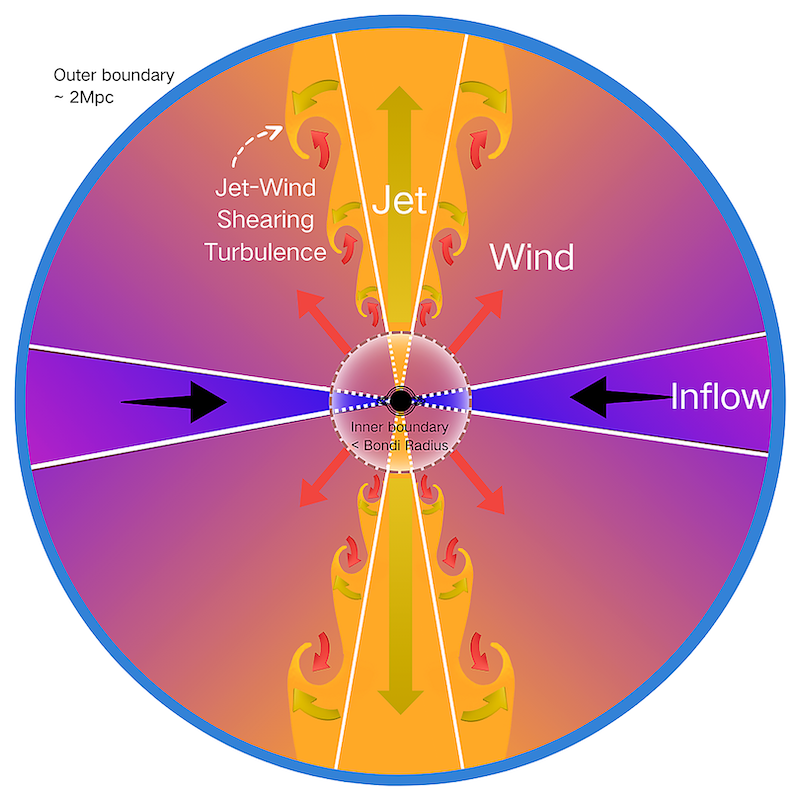
Solving the cooling-flow problem with jet-wind feedback
Cluster-scale MACER simulations show that GRMHD-informed jets and winds act together: shear-driven turbulence converts kinetic energy into heat and reproduces key Perseus-like cooling-flow observables.
Related paper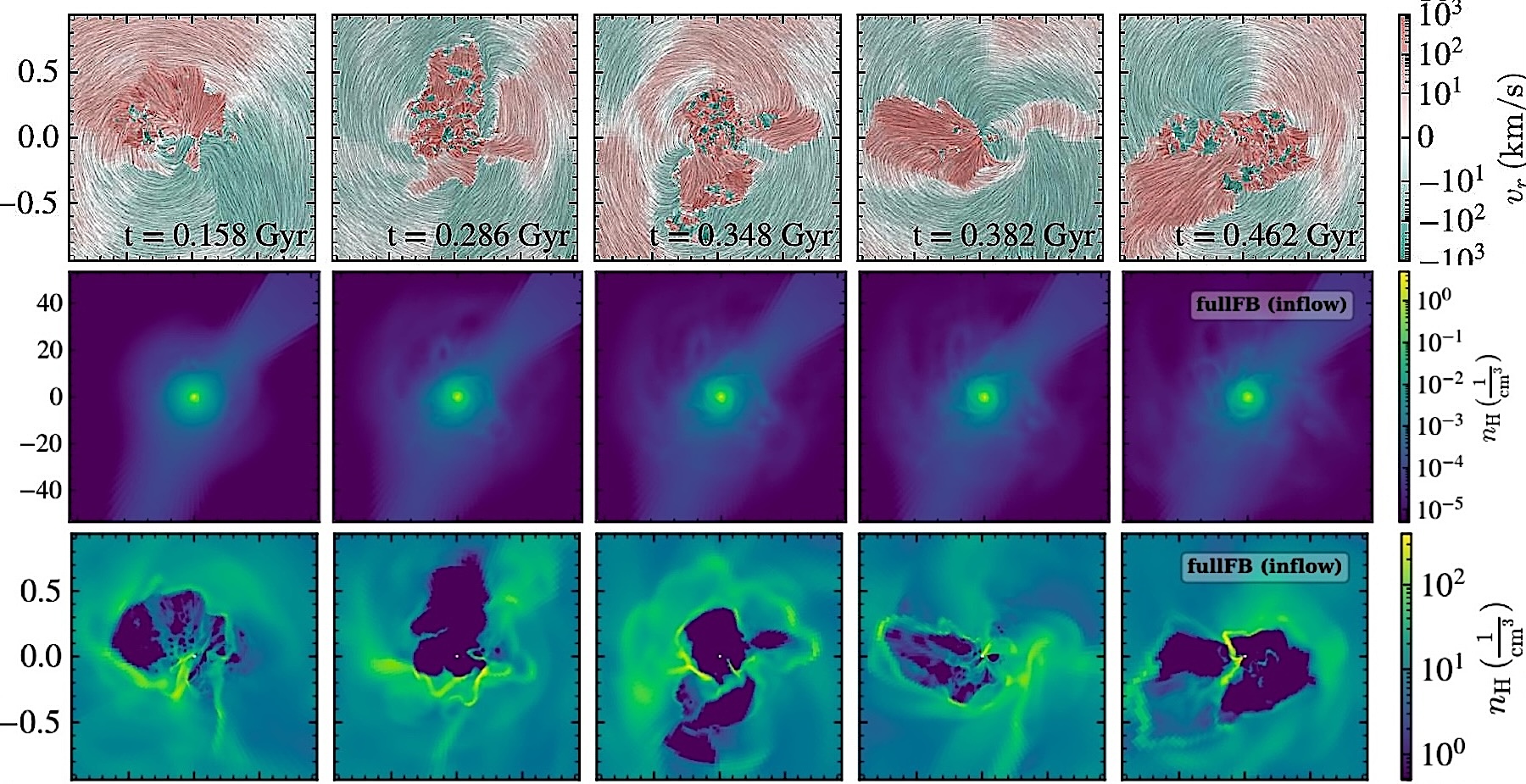
Dwarf galaxies
Positive AGN feedback in gas-rich starbursts
In dense, efficiently cooling dwarf environments, moderate AGN outflows can compress gas and enhance star formation when supernova feedback regulates the black-hole activity.
Related paper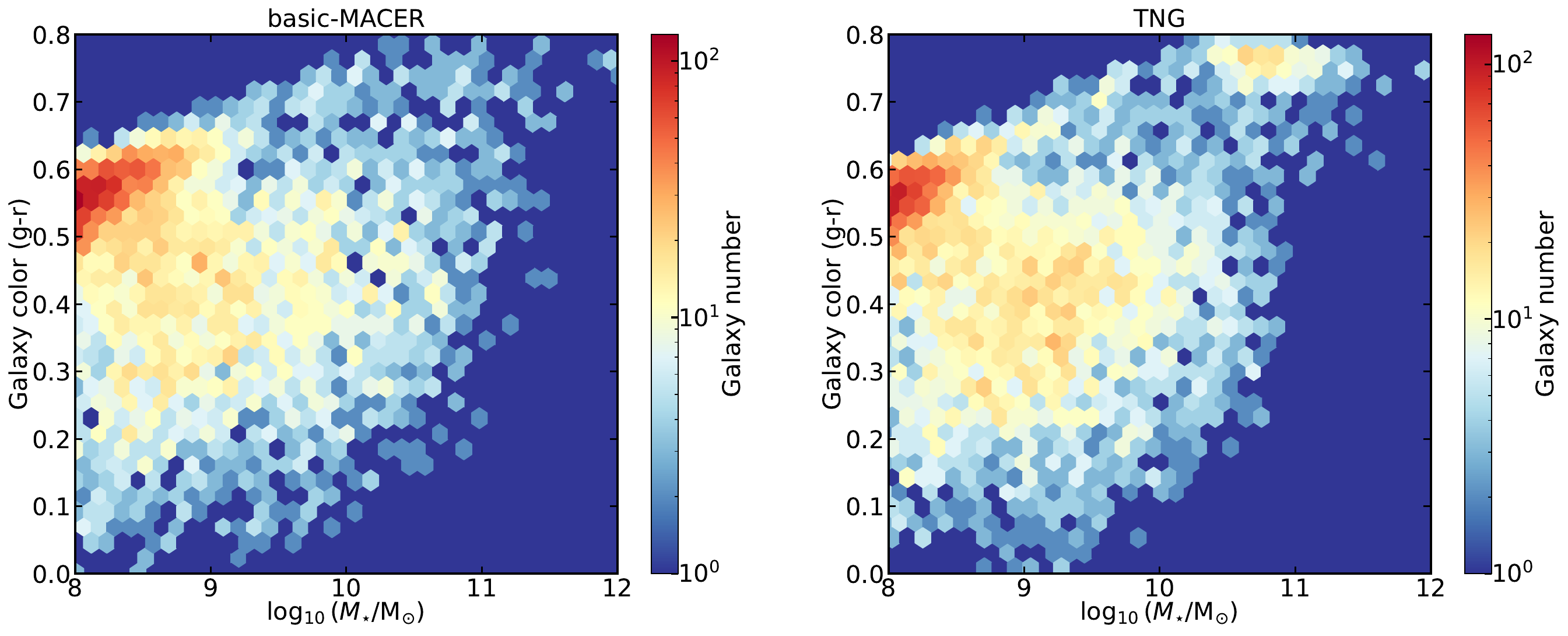
MACER-TNG cosmological simulations
Physically grounded AGN feedback at cosmological scale
Embedding MACER-based high- and low-accretion-rate feedback prescriptions in IllustrisTNG yields broadly similar galaxy populations through black-hole self-regulation, while producing milder quenching in massive galaxies and a less pronounced colour bimodality.
Related paper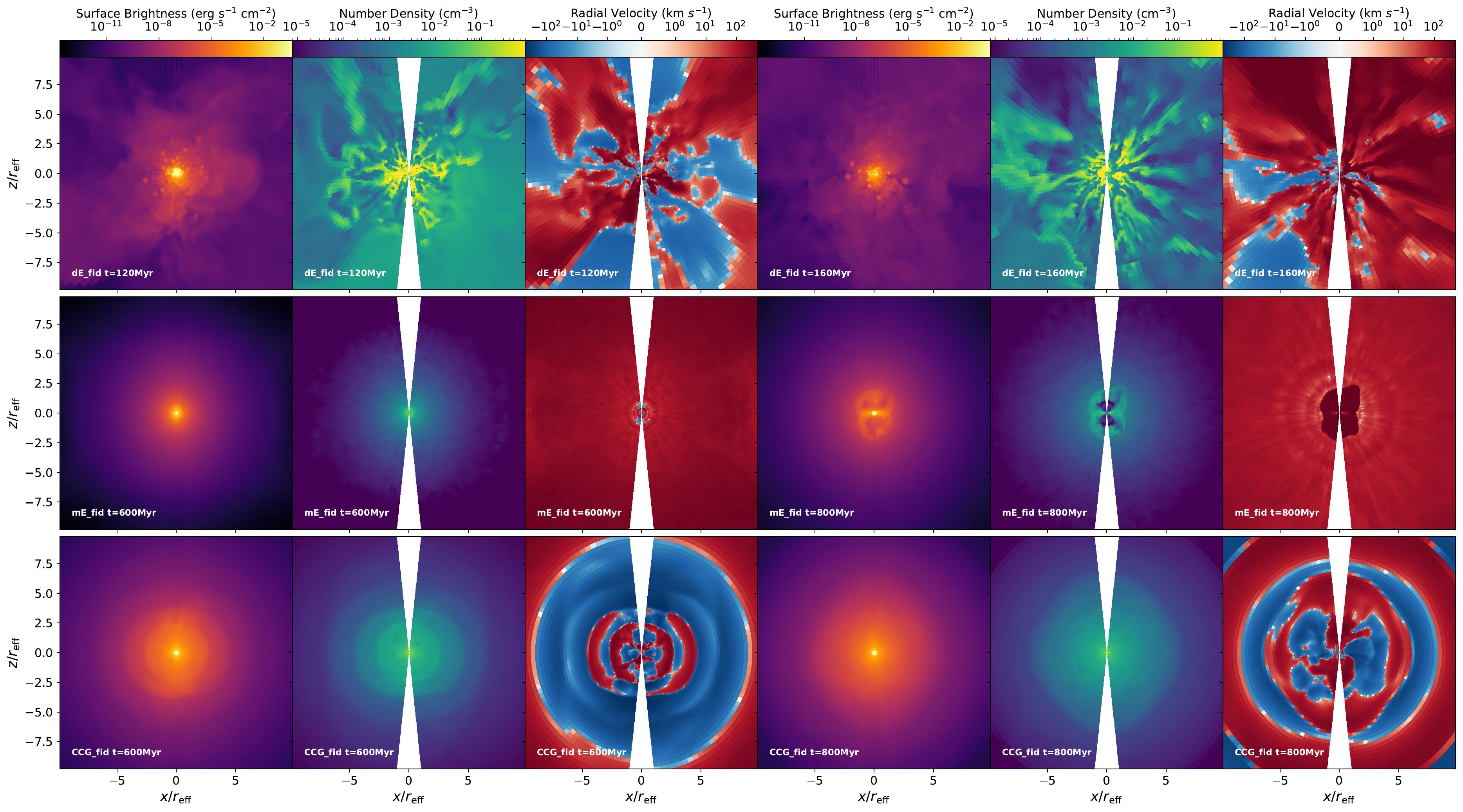
X-ray / Xia et al., MACER Lx-T simulation suite
Mass-dependent regulation of hot galactic atmospheres
MACER simulations connect dwarf ellipticals, massive ellipticals, and cluster-central galaxies to the X-ray luminosity-temperature relation, isolating how AGN and supernova feedback shape hot gas across halo mass.
View gallery figure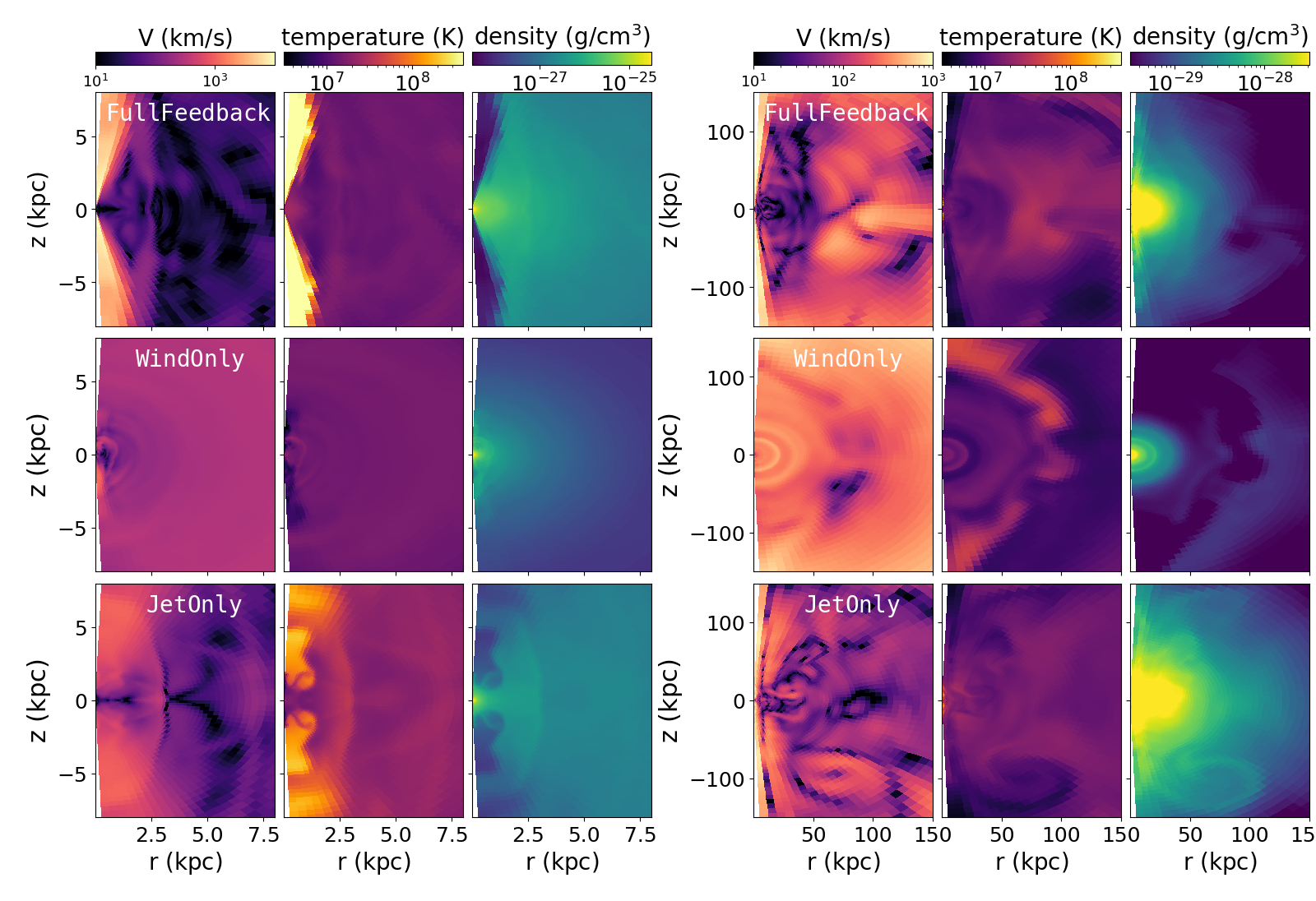
Jets, winds, and turbulence
Nonlinear coupling of AGN output channels
Jet-wind interaction generates shear-driven turbulence, increases heating efficiency, and suppresses star-forming cool gas more effectively than either channel alone.
Related paperScientific capabilities
A controlled laboratory for feedback physics.
Three-dimensional Eulerian gas dynamics in spherical coordinates, with logarithmic radial spacing for central resolution.
Inner boundaries are placed inside the Bondi radius where feasible, reducing reliance on boosted Bondi estimates.
Cold and hot accretion states drive radiation, winds, and, in active development branches, jet feedback.
Cooling and heating depend on gas density, metallicity, redshift, and AGN radiation field where implemented.
Cold, dense gas can form stars following threshold-based prescriptions tied to galactic-scale gas evolution.
Supernova and stellar mass-loss modules couple energy, momentum, and metals to the multiphase ISM and CGM.
MACER3D tracks metal transport and halo-scale enrichment driven by the combined action of AGN and stellar feedback.
Magnetic fields, cosmic rays, and more complete hot-mode jet physics are natural extensions of the framework.
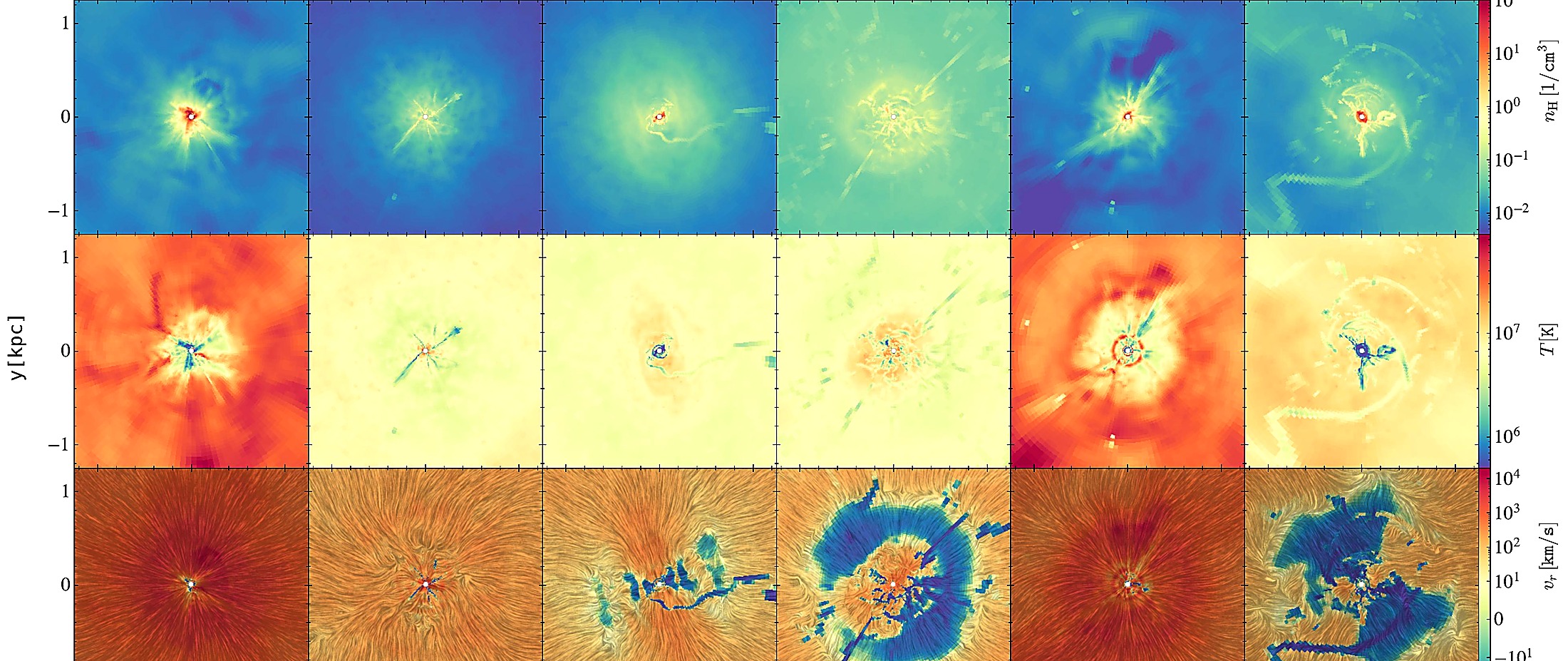
Visualization gallery
Simulation diagnostics and synthetic observables.
Explore simulation diagnostics, synthetic observables, and multi-scale views of AGN-regulated galaxy ecosystems.
Project timeline
A decade of increasingly physical AGN feedback experiments.
Updated MACER physics
Low- and high-angular-momentum elliptical galaxy studies establish resolved Bondi-scale accretion and updated wind/radiation feedback.
Hot feedback mode
The role of hot-mode wind feedback is isolated in early-type galaxy evolution.
Environment and quasar winds
Cosmological inflow and cold-mode wind dominance are tested in controlled elliptical galaxy simulations.
MACER3D
The new three-dimensional framework debuts with enhanced subgrid gas physics and Gyr-scale massive elliptical simulations.
Expanded ecosystems
Dwarfs, clusters, disk galaxies, radio shocks, and MACER-informed cosmological modeling broaden the project scope.
Publications
MACER papers.
Peer-reviewed and preprint papers describing the MACER framework, its physical extensions, and its applications across galaxy and cluster environments.
Data and code
Designed for high-quality AGN-feedback science products.
Reduced data products, derived catalogs, and analysis material are shared through scientific collaboration. Researchers interested in using MACER datasets are welcome to contact us at fyuan@fudan.edu.cn or sqji@fudan.edu.cn.
Snapshot archive
Runs and model variants provide time-resolved views of accretion, outflows, multiphase gas, star formation, and halo response.
Observables
Science products include AGN duty cycles, star formation histories, X-ray properties, metal profiles, and synthetic radio quantities.
User guide
Numerical assumptions, units, boundary conditions, and feedback prescriptions are documented alongside the corresponding science papers.
Analysis workflows
Workflows support visualization, radial profiles, light curves, synthetic observables, and publication-quality figure generation.
Team

Faculty
Feng Yuan
Professor, Department of Physics, Fudan University; Director, Center for Astronomy and Astrophysics. Research interests include black-hole accretion, active galactic nuclei, galaxy formation and evolution, and computational astrophysics.
Fudan profile
Faculty
Suoqing Ji
Associate Professor, Center for Astronomy and Astrophysics, Department of Physics, Fudan University. Research interests include galaxy formation, the circumgalactic medium, galactic feedback, cosmic rays, turbulence, and magnetohydrodynamics.
Fudan profileStudents and Postdocs (including Alumni)
- Yihuan Di
- Minhang Guo
- Aoyun He
- Yihan Jin
- Tingfang Su
- Aditi Vijayan
- Haocheng Wang
- Haojie Xia
- Zhiyuan Yao
- Doosoo Yoon
- Haoen Zhang
- Rui Zhang
- Bocheng Zhu
- Yuxuan Zou
For citations, cite the relevant science paper and include the MACER3D framework paper where appropriate.
Contact
Fudan Center for Astronomy and Astrophysics
2005 Songhu Road, Shanghai 200438, China